1.Introduction
This chapter provides an in-depth introduction to the technical architecture, design philosophy, and innovative features of the Xiaozhi AIoT Intelligent Control System, helping you comprehensively understand this next-generation IoT control system based on the MCP protocol.
Technical Background
xiaozhi-esp32 Open Source Project
The Xiaozhi AIoT system used in this project is built on the open-source xiaozhi-esp32 project, a mature ESP32 AI voice assistant framework that supports secondary development.
If you only want to use the device, you can follow the flashing tutorial directly without building the source code yourself. If you want to customize features or continue development, refer to Open Source and Secondary Development.
The project provides the following technical foundations:
Rich Hardware Ecosystem: Supports over 70 different development board configurations
Multi-chip Platform: ESP32-S3, ESP32-C3, ESP32-P4, and more
Complete Voice Pipeline: Offline wake-up + Streaming ASR + LLM + TTS
Multi-language Support: Chinese, English, Japanese, and other language recognition
Network Connectivity: Wi-Fi, 4G, and various connection methods
Building on this foundation, our project utilizes the MCP protocol to upgrade traditional voice assistants into AI-native IoT control centers.
MCP Protocol Technical Principles
What is the MCP Protocol
MCP (Model Context Protocol) is an emerging standard protocol specifically designed for interaction between AI large language models and external tools/systems. It is based on the JSON-RPC 2.0 specification and provides a standardized mechanism for tool discovery and invocation.
Comparison with Traditional IoT Protocols
Traditional IoT control methods have the following issues:
Protocol Fragmentation: Different devices use different control protocols
High Learning Curve: Users need to learn complex command formats
Poor Scalability: Adding new features requires modifying the entire system
Difficult AI Understanding: Large models cannot directly understand device capabilities
Core advantages of the MCP protocol:
Standardization: Unified JSON-RPC 2.0 message format
Self-describing: Tools come with parameter and functionality descriptions
AI-friendly: Large models can directly understand tool definitions
Easy Extension: Dynamic registration of new tools without modifying clients
MCP Workflow
Connection Establishment and Tool Discovery
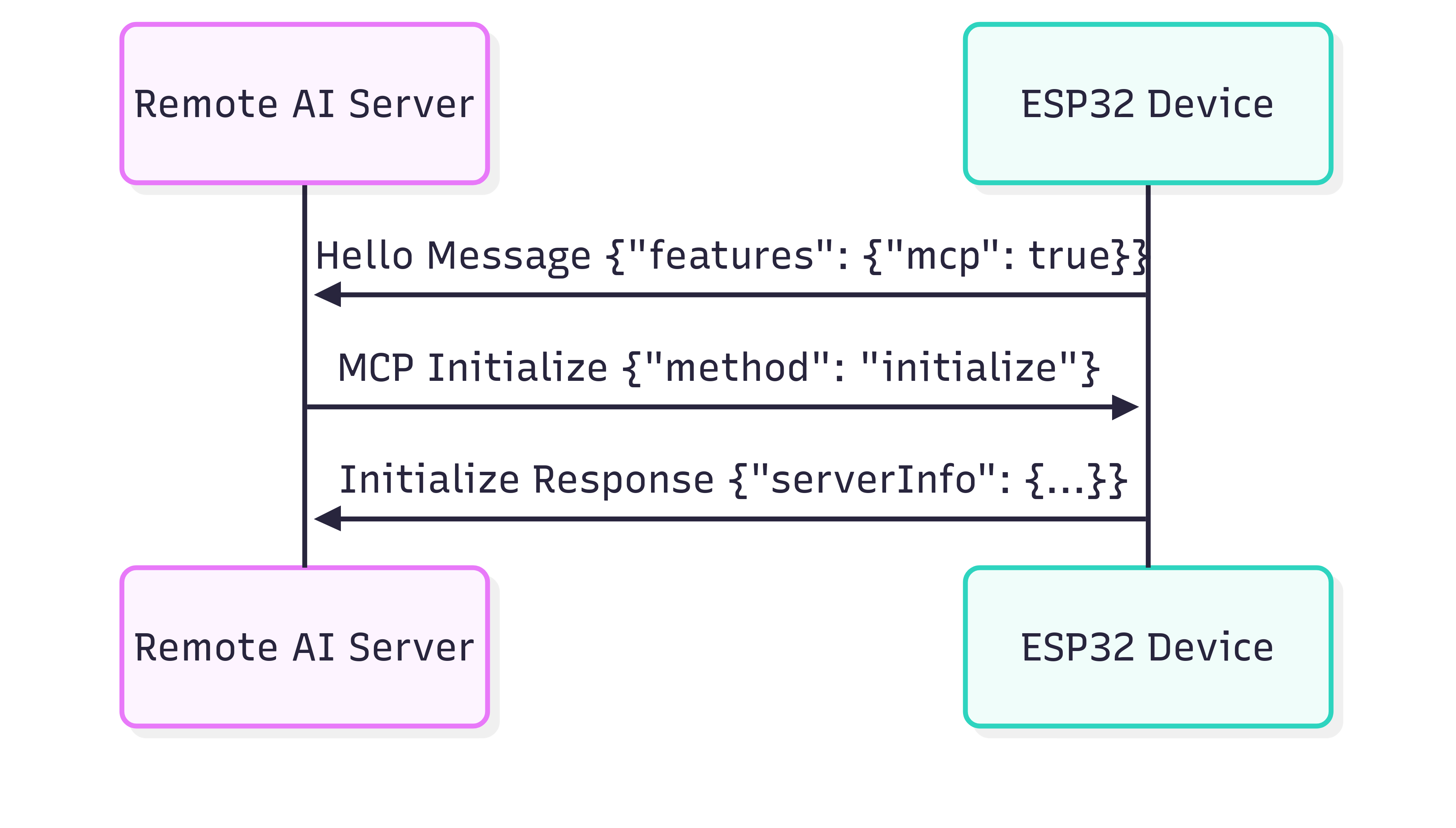
MCP Connection Establishment and Capability Negotiation Process
Device Control Execution Flow
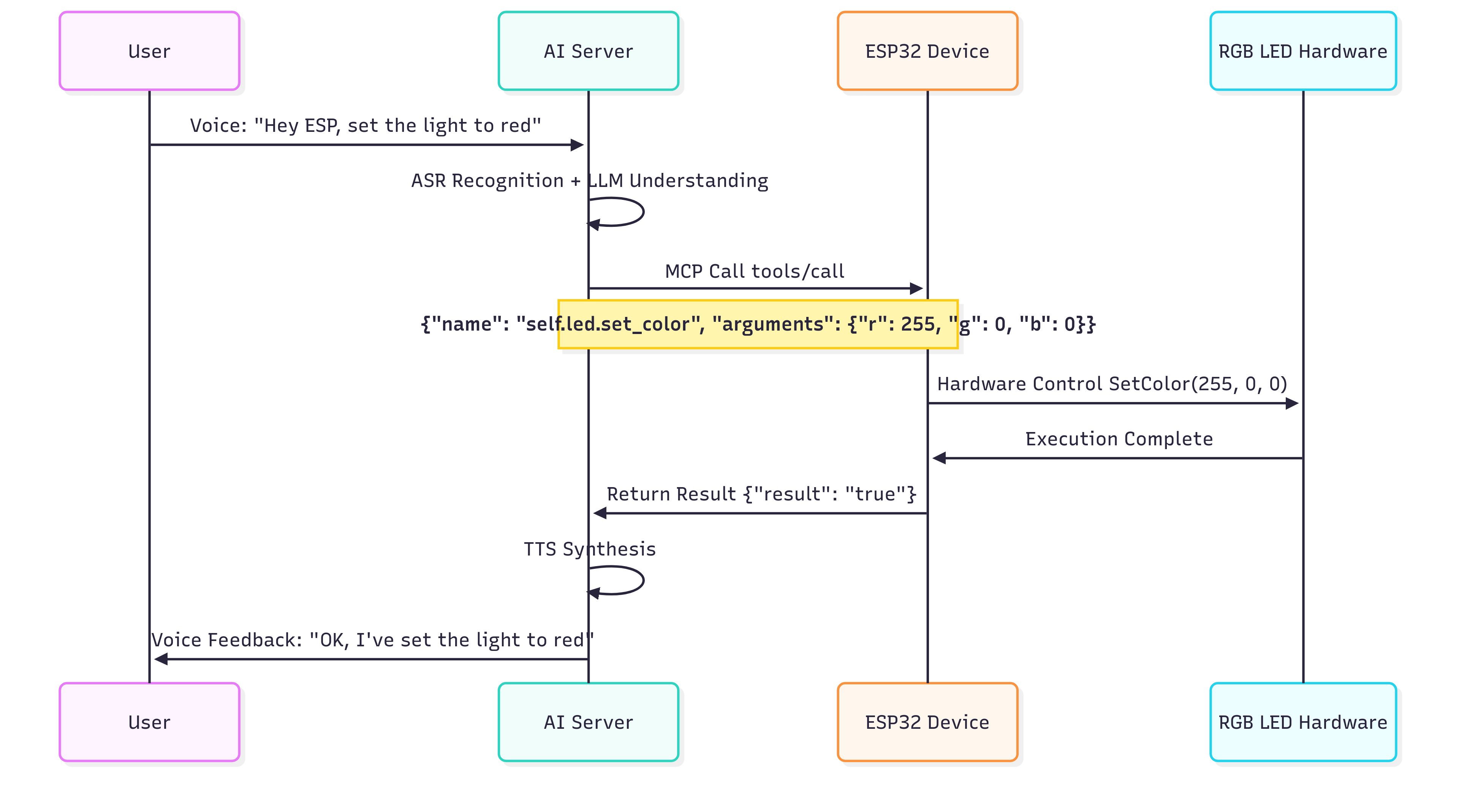
Complete flow from voice commands to hardware control
Core Concept Explanation
Tools: Functional units provided by the device side, such as “Set LED Color”, “Read Temperature”
Server: ESP32 device acts as MCP server, registering and providing tools
Client: AI backend service acts as MCP client, discovering and invoking tools
Session: Communication session between client and server
MCP Implementation in ESP32
Tool Registration Example
In the xiaozhi-esp32 project, hardware functions are exposed to the AI system in the form of MCP tools:
{
  "name": "self.led.set_color",
  "description": "Set RGB LED color, supports RGB values from 0-255",
  "inputSchema": {
    "type": "object",
    "properties": {
      "r": {"type": "integer", "minimum": 0, "maximum": 255},
      "g": {"type": "integer", "minimum": 0, "maximum": 255},
      "b": {"type": "integer", "minimum": 0, "maximum": 255}
    }
  }
}
Such tool definitions enable AI large models to:
Understand Functionality: Know this is a tool for controlling LED colors
Master Parameters: Understand that three RGB integer parameters from 0-255 are needed
Generate Calls: Automatically generate correct call requests based on user voice input
System Architecture Design
Overall Architecture
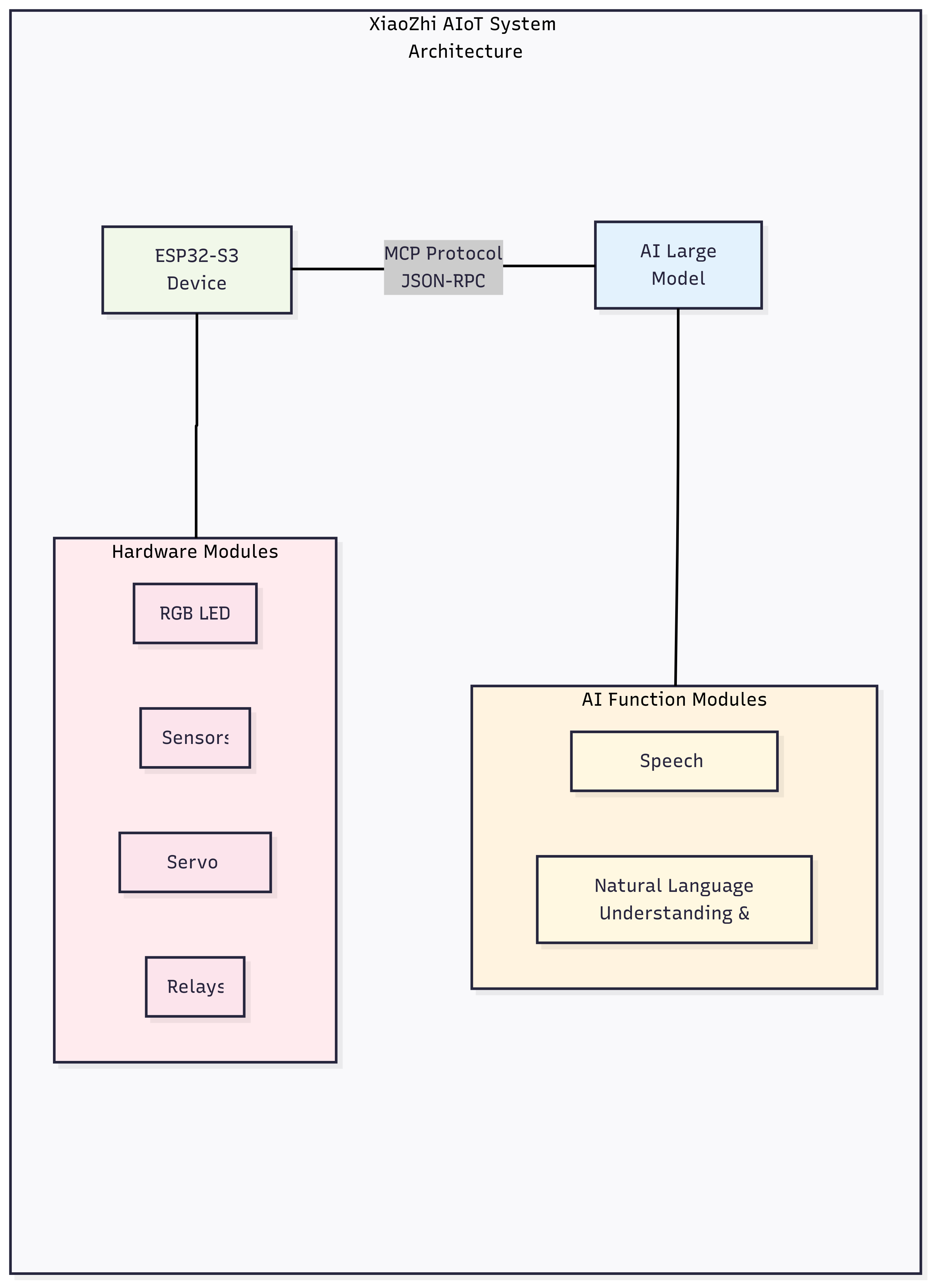
The xiaozhi-esp32 AIoT system adopts a layered architecture design, implementing a complete pipeline from user voice to hardware control.
Software Architecture Layers
┌─────────────────────────────────────┐
│          Application Layer          │  ← Voice interaction, device management
├─────────────────────────────────────┤
│         MCP Protocol Layer          │  ← Tool registration, message processing
├─────────────────────────────────────┤
│       Hardware Abstraction Layer    │  ← Unified hardware interfaces
├─────────────────────────────────────┤
│        Device Driver Layer          │  ← LED, sensors, servos, etc.
├─────────────────────────────────────┤
│    System Layer (ESP-IDF/FreeRTOS)  │  ← Task scheduling, memory management
└─────────────────────────────────────┘
Key Design Features
MCP Protocol Layer - Standardized tool registration mechanism - JSON-RPC 2.0 message processing - Asynchronous execution to avoid blocking - Error handling and state management
Hardware Abstraction Layer - Unified hardware interface design - Support for 70+ development boards - Configurable GPIO mapping - Modular driver architecture
Concurrent Processing - FreeRTOS task scheduling - Non-blocking I/O operations - Real-time response guarantee - Memory-efficient management
System Technical Features
Dual-Core Concurrent Architecture
The dual-core design of ESP32-S3 achieves efficient task separation:
Core 0: MCP protocol communication, Wi-Fi connection, voice processing
Core 1: Hardware I/O, sensor data collection, actuator control
Memory Management Optimization
Core components use static memory to avoid fragmentation
MCP message processing uses dynamic memory pools
Real-time memory monitoring ensures stable system operation
Secondary Development Technical Requirements
This project requires setting up Espressif’s ESP-IDF environment and mastery of C++ development skills. It is suitable for technical personnel with embedded or IoT development background to customize and extend.
Core Technical Requirements
ESP-IDF 5.4+: Espressif’s official development framework
C++ Programming: Modern C++ features, object-oriented design
Embedded Development: FreeRTOS, hardware interface programming
Network Protocols: JSON-RPC, WebSocket communication
For in-depth customization, it is recommended to refer to the official ESP-IDF documentation and the xiaozhi-esp32 open source project.